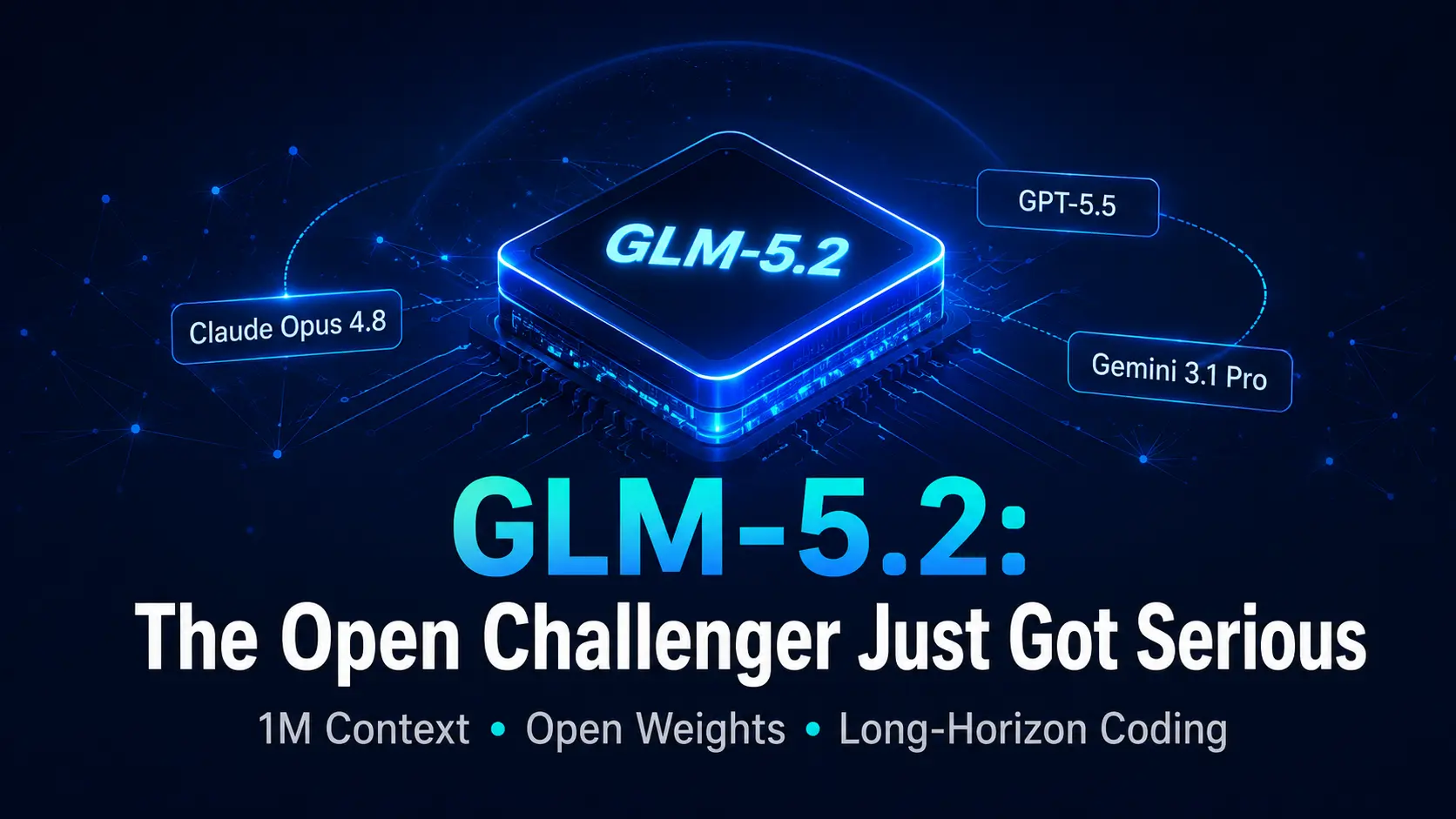
GLM-5.2 is one of those updates that is easy to underestimate.
At first glance, it sounds like another “bigger context window” release. But the real story is not just 1M context. The real story is whether that context can stay useful across long engineering workflows.
That is where GLM-5.2 becomes interesting.
Z.ai is positioning it around long-horizon coding, project-scale context, tool use, and more stable execution across multi-step software tasks. In simple terms: not just answering prompts, but staying consistent while working through larger development jobs.
The comparison with competitors is what makes it worth watching:
Claude Opus 4.8 still looks like a premium choice for advanced agentic coding and autonomous workflows. Anthropic positions it as a high-capability model for complex reasoning, long-horizon agentic coding, and high-autonomy work.
GPT-5.5 has the advantage of ecosystem, product integration, and broad professional workflows across coding, research, analysis, and document-heavy work.
Gemini 3.1 Pro remains strong for reasoning and Google ecosystem integration, especially for complex tasks across Google’s AI stack.
But GLM-5.2 brings a different angle: open weights + strong coding benchmarks + aggressive pricing.
According to Z.ai’s own documentation, GLM-5.2 has a 1M context window, 128K maximum output tokens, function calling, structured output, MCP support, and context caching. Z.ai also claims it ranks as the strongest open-source model across several long-horizon coding benchmarks and comes close to Claude Opus 4.8 on Terminal-Bench 2.1.
The pricing is also a big part of the story: GLM-5.2 is listed at $1.40 per 1M input tokens and $4.40 per 1M output tokens, compared with GPT-5.5 at $5 input / $30 output and Claude Opus 4.8 at $5 input / $25 output.
My take:
GLM-5.2 may not automatically replace Claude, GPT, or Gemini for every use case. Closed frontier models still have strong product ecosystems, reliability advantages, and enterprise trust.
But for developers, startups, and AI builders who care about cost, control, and open model flexibility, GLM-5.2 is a serious signal.
The AI race is no longer just about who has the smartest model.
It is becoming about who can deliver the best mix of:
- capability
- context
- cost
- openness
- developer usability
And GLM-5.2 has pushed that conversation forward.
Open models are not just catching up anymore.
They are becoming real competitors.